Why Parents Choose HEWS
One of the Top Schools in Hyderabad
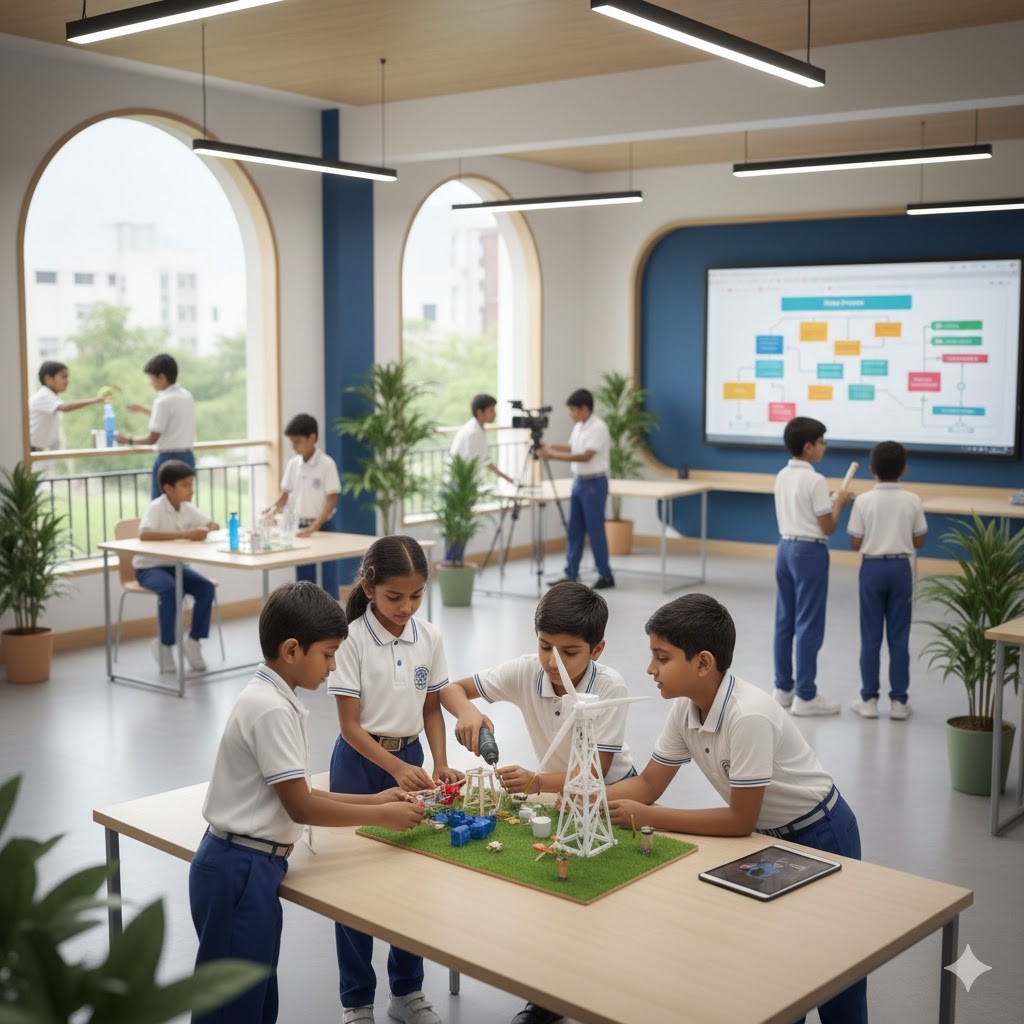
Project-Based Learning (PBL) at HEWS is a natural extension of our core purpose, which is designing children as confident, capable humans prepared for tomorrow’s world. Through structured exploration and hands-on problem-solving, students develop the deeper understanding and adaptable skills required for a rapidly evolving global landscape.
1. Authentic and Meaningful Challenges
Every project at HEWS begins with an essential question or a real-world issue that feels relevant to children’s lives and their community. These authentic contexts help students see purpose in what they learn, promoting intrinsic motivation and ownership.
Instead of simply studying environmental science, students may design a sustainable waste-management solution for the school. By engaging with the world around them, students learn to connect knowledge to action and information to impact.
2. Student Voice and Choice
Aligned with our belief that every child is unique, HEWS PBL intentionally creates space for student autonomy. Children make decisions about how they approach a problem, how they collaborate, what resources they use, and how they present their final work.
This deliberate encouragement of voice and choice builds self-awareness, confidence, and a sense of agency. Students learn not just to participate, but to lead, question, and create.
3. Rigorous Inquiry and Innovation
Inquiry is at the heart of experiential learning at HEWS. Projects follow a structured cycle where students ask questions, conduct research, analyze information, test ideas, and revise their work based on critique and reflection.
This rigorous approach ensures that students engage with academic depth while building transferable skills like data interpretation, problem analysis, and iterative thinking. Innovation becomes a natural outcome of disciplined inquiry.
4. Collaboration and Communication
HEWS places high emphasis on collaboration as a life skill, just as important as subject knowledge. PBL mirrors real-world professional environments where teamwork, perspective-taking, and communication are critical. Students learn to negotiate ideas, divide roles, listen actively, and present their reasoning clearly.
Whether writing a report, designing a prototype, recording a documentary, or defending their solution, students strengthen their ability to communicate with clarity and confidence. These experiences directly shape the self-image our brand aspires to: thoughtful contributors and responsible global citizens.
5. Formative and Summative Assessment
Assessment at HEWS is holistic, continuous, and growth-centered. Teachers guide students with ongoing feedback, reflection prompts, and revision cycles throughout the project. Summative assessments evaluate not only the final product but also the process; planning, research, teamwork, and the student’s ability to articulate what they learned.
This approach reinforces a growth mindset and helps students develop emotional balance, resilience, and clarity. They learn to value effort, reflection, and improvement rather than chasing perfection.
6. Integrating PBL Across the HEWS Curriculum
Project-Based Learning is not a standalone approach at HEWS; it is woven into all subject domains and age groups through interdisciplinary design.
Science and Technology
Students apply scientific concepts and technological tools to solve engineering or environmental challenges.
Humanities and Arts
Interdisciplinary projects integrate literature, history, visual arts, and social sciences. Students may create a documentary or develop a persuasive campaign around a civic issue.
These experiences foster empathy, storytelling, ethical reasoning, and cultural awareness.
Mathematics
Mathematical concepts are applied to real-life contexts. Students see mathematics as a tool for reasoning, decision-making, and problem-solving, not memorization.
Through this integrated approach, HEWS ensures that academic knowledge becomes lived knowledge; understood, applied, and remembered.