

Unlock Your Academic Potential
Campus Facilities
Classrooms, studios, libraries, outdoor areas, and shared spaces form an integrated learning environment.
Campus Facilities
Classrooms, studios, libraries, outdoor areas, and shared spaces form an integrated learning environment.
Campus Facilities
Classrooms, studios, libraries, outdoor areas, and shared spaces form an integrated learning environment.
Clubs & Societies
Clubs span arts, technology, environment, debate, music, and student-led interest groups.
Clubs & Societies
Clubs span arts, technology, environment, debate, music, and student-led interest groups.
Clubs & Societies
Clubs span arts, technology, environment, debate, music, and student-led interest groups.
Sports & Athletics
Daily schedules include free play, structured sports, fitness activities, and outdoor movement.
Sports & Athletics
Daily schedules include free play, structured sports, fitness activities, and outdoor movement.
Sports & Athletics
Daily schedules include free play, structured sports, fitness activities, and outdoor movement.
Events & Gallery
The school calendar includes exhibitions, performances, project showcases, and community gatherings.
Events & Gallery
The school calendar includes exhibitions, performances, project showcases, and community gatherings.
Events & Gallery
The school calendar includes exhibitions, performances, project showcases, and community gatherings.
Curriculum Approach
Curriculum Approach
Curriculum Approach
Relevant and Balanced Learning
Programs
Integrated Learning
Learning unfolds through connected themes, real contexts, and interdisciplinary exploration rather than isolated subjects.
Integrated Learning
Learning unfolds through connected themes, real contexts, and interdisciplinary exploration rather than isolated subjects.
Integrated Learning
Learning unfolds through connected themes, real contexts, and interdisciplinary exploration rather than isolated subjects.
STEM & Inquiry
Questions, experiments, design thinking, and problem-solving shape how students engage with science and technology
STEM & Inquiry
Questions, experiments, design thinking, and problem-solving shape how students engage with science and technology
STEM & Inquiry
Questions, experiments, design thinking, and problem-solving shape how students engage with science and technology
Creative Expression
Art, music, movement, and performance form essential pathways for thinking, reflection, and emotional expression.
Creative Expression
Art, music, movement, and performance form essential pathways for thinking, reflection, and emotional expression.
Creative Expression
Art, music, movement, and performance form essential pathways for thinking, reflection, and emotional expression.
Leadership & Citizenship
Voice, responsibility, collaboration, and ethical thinking develop through participation, dialogue, and community engagement.
Leadership & Citizenship
Voice, responsibility, collaboration, and ethical thinking develop through participation, dialogue, and community engagement.
Leadership & Citizenship
Voice, responsibility, collaboration, and ethical thinking develop through participation, dialogue, and community engagement.
Subjects
Mathematics
From arithmetic to calculus, our math curriculum builds essential problem-solving and analytical skills.
Mathematics
From arithmetic to calculus, our math curriculum builds essential problem-solving and analytical skills.
Mathematics
From arithmetic to calculus, our math curriculum builds essential problem-solving and analytical skills.
Science
Experiments in biology, chemistry, physics, and science enhance understanding of the natural world.
Science
Experiments in biology, chemistry, physics, and science enhance understanding of the natural world.
Science
Experiments in biology, chemistry, physics, and science enhance understanding of the natural world.
Language Arts
Focus on reading, writing, and communication to enhance literacy and critical thinking through public speaking.
Language Arts
Focus on reading, writing, and communication to enhance literacy and critical thinking through public speaking.
Language Arts
Focus on reading, writing, and communication to enhance literacy and critical thinking through public speaking.
Social Studies
Explore history, geography, economics, and civics to build global awareness and informed citizenship.
Social Studies
Explore history, geography, economics, and civics to build global awareness and informed citizenship.
Social Studies
Explore history, geography, economics, and civics to build global awareness and informed citizenship.
Foreign Languages
Learn Spanish, French, and Mandarin to develop language skills and cross-cultural communication.
Foreign Languages
Learn Spanish, French, and Mandarin to develop language skills and cross-cultural communication.
Foreign Languages
Learn Spanish, French, and Mandarin to develop language skills and cross-cultural communication.
Physical Education
Our PE program promotes fitness, teamwork, and lifelong healthy habits for student development.
Physical Education
Our PE program promotes fitness, teamwork, and lifelong healthy habits for student development.
Physical Education
Our PE program promotes fitness, teamwork, and lifelong healthy habits for student development.
Computer Science
Acquire key tech skills in coding, web development, and digital media to prepare for future careers.
Computer Science
Acquire key tech skills in coding, web development, and digital media to prepare for future careers.
Computer Science
Acquire key tech skills in coding, web development, and digital media to prepare for future careers.
Fine Arts
Express creativity and appreciate artistic disciplines through music, visual arts, and performing arts.
Fine Arts
Express creativity and appreciate artistic disciplines through music, visual arts, and performing arts.
Fine Arts
Express creativity and appreciate artistic disciplines through music, visual arts, and performing arts.
Stages
Stages
Stages
Grade Levels and Curriculum Overview
01
Ages 3–5 | Finnish Early Years Curriculum
Early Years (Nursery – PP2)
The Early Years programme is rooted in play-based and child-led learning. Children develop social, emotional, language, and motor skills through storytelling, music, movement, nature exploration, and sensory experiences. Learning environments are designed to feel safe, joyful, and stimulating, nurturing curiosity, confidence, independence, and a lifelong love for learning without pressure or formal assessment.

01
Ages 3–5 | Finnish Early Years Curriculum
Early Years (Nursery – PP2)
The Early Years programme is rooted in play-based and child-led learning. Children develop social, emotional, language, and motor skills through storytelling, music, movement, nature exploration, and sensory experiences. Learning environments are designed to feel safe, joyful, and stimulating, nurturing curiosity, confidence, independence, and a lifelong love for learning without pressure or formal assessment.

01
Ages 3–5 | Finnish Early Years Curriculum
Early Years (Nursery – PP2)
The Early Years programme is rooted in play-based and child-led learning. Children develop social, emotional, language, and motor skills through storytelling, music, movement, nature exploration, and sensory experiences. Learning environments are designed to feel safe, joyful, and stimulating, nurturing curiosity, confidence, independence, and a lifelong love for learning without pressure or formal assessment.

02
Ages 6–10 | Finnish Curriculum
Elementary School (Grades 1–5)
Elementary School focuses on building strong foundations in literacy, numeracy, and inquiry-based learning. Students engage in integrated projects that combine science, language, arts, and real-world problem-solving. Creativity, collaboration, and independent thinking are encouraged through experiential activities, reading habits, movement, and reflection, helping children grow as confident learners with strong values and learning skills.

02
Ages 6–10 | Finnish Curriculum
Elementary School (Grades 1–5)
Elementary School focuses on building strong foundations in literacy, numeracy, and inquiry-based learning. Students engage in integrated projects that combine science, language, arts, and real-world problem-solving. Creativity, collaboration, and independent thinking are encouraged through experiential activities, reading habits, movement, and reflection, helping children grow as confident learners with strong values and learning skills.

02
Ages 6–10 | Finnish Curriculum
Elementary School (Grades 1–5)
Elementary School focuses on building strong foundations in literacy, numeracy, and inquiry-based learning. Students engage in integrated projects that combine science, language, arts, and real-world problem-solving. Creativity, collaboration, and independent thinking are encouraged through experiential activities, reading habits, movement, and reflection, helping children grow as confident learners with strong values and learning skills.

03
Ages 11–18 | CBSE & IB Pathways
Middle & High School (Grades 6–12)
Middle and High School education emphasizes academic depth, skill development, and real-world readiness. Middle School introduces subject specialization, STEM labs, research, and communication skills. High School follows CBSE till Grade 10 and the IB Career-related Programme till Grade 12, supporting informed choices, applied learning, and preparation for higher education and future careers.

03
Ages 11–18 | CBSE & IB Pathways
Middle & High School (Grades 6–12)
Middle and High School education emphasizes academic depth, skill development, and real-world readiness. Middle School introduces subject specialization, STEM labs, research, and communication skills. High School follows CBSE till Grade 10 and the IB Career-related Programme till Grade 12, supporting informed choices, applied learning, and preparation for higher education and future careers.

03
Ages 11–18 | CBSE & IB Pathways
Middle & High School (Grades 6–12)
Middle and High School education emphasizes academic depth, skill development, and real-world readiness. Middle School introduces subject specialization, STEM labs, research, and communication skills. High School follows CBSE till Grade 10 and the IB Career-related Programme till Grade 12, supporting informed choices, applied learning, and preparation for higher education and future careers.

Paths to Excellence
Paths to Excellence
Paths to Excellence
Spaces That Create Opportunity
Personalised Learning Journey
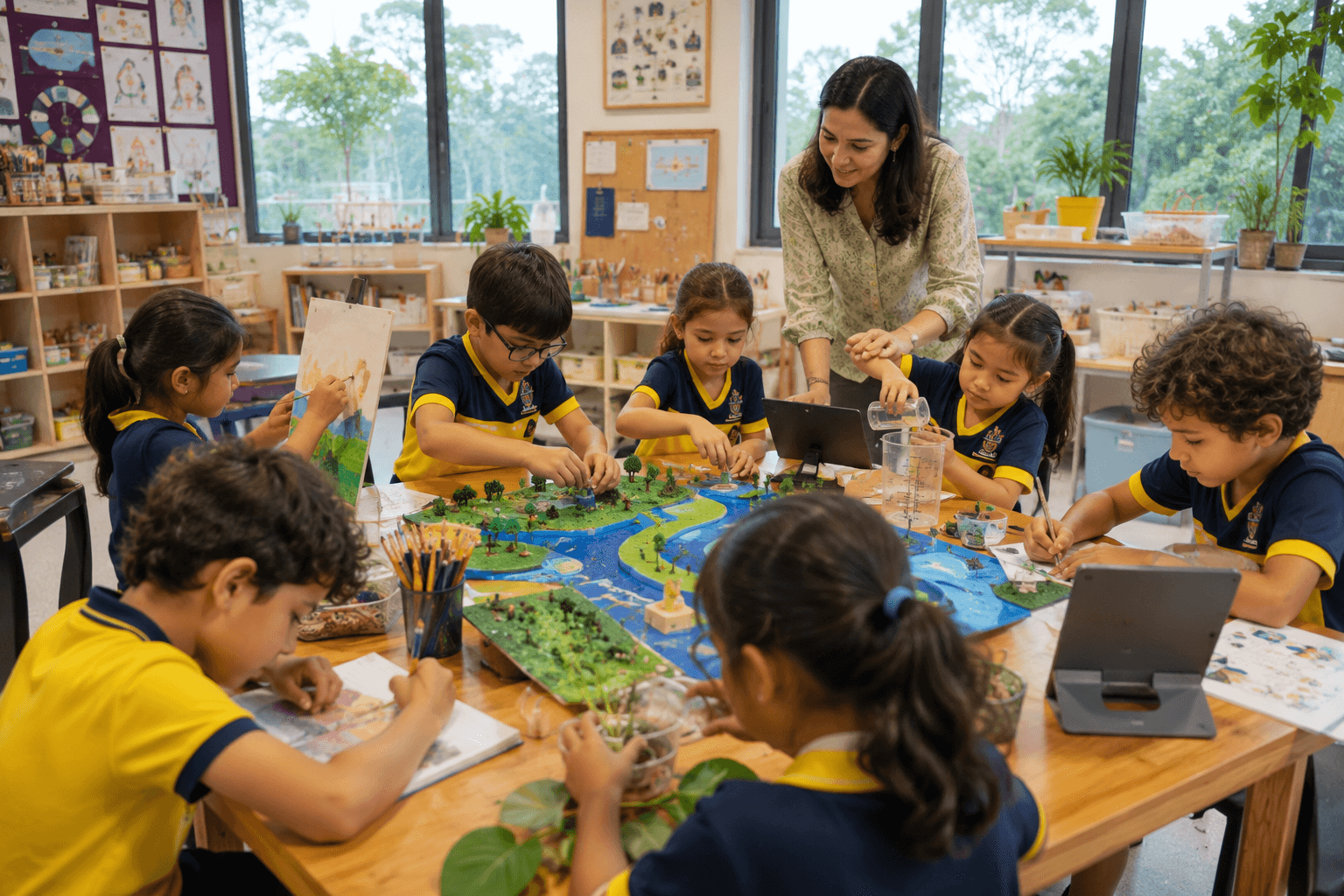
Students learn at their own pace through differentiated instruction, small-group learning, and teacher guidance. Learning experiences are designed to support individual strengths, interests, and need; ensuring every child feels seen, supported, and confident in their learning journey.

Personalised Learning Journey
Students learn at their own pace through differentiated instruction, small-group learning, and teacher guidance. Learning experiences are designed to support individual strengths, interests, and need; ensuring every child feels seen, supported, and confident in their learning journey.

Personalised Learning Journey
Students learn at their own pace through differentiated instruction, small-group learning, and teacher guidance. Learning experiences are designed to support individual strengths, interests, and need; ensuring every child feels seen, supported, and confident in their learning journey.

Learning Beyond Boundaries
Flexible classrooms, studios, labs, and open environments encourage students to explore ideas, collaborate meaningfully, and learn through experience rather than instruction alone. Learning flows across disciplines and spaces, nurturing curiosity, independence, and real-world understanding.

Learning Beyond Boundaries
Flexible classrooms, studios, labs, and open environments encourage students to explore ideas, collaborate meaningfully, and learn through experience rather than instruction alone. Learning flows across disciplines and spaces, nurturing curiosity, independence, and real-world understanding.

Learning Beyond Boundaries
Flexible classrooms, studios, labs, and open environments encourage students to explore ideas, collaborate meaningfully, and learn through experience rather than instruction alone. Learning flows across disciplines and spaces, nurturing curiosity, independence, and real-world understanding.

Future-Ready Thinking
Students develop thinking skills that matter beyond exams like critical inquiry, adaptability, creativity, and problem-solving. Through projects, reflection, and interdisciplinary learning, children learn how to think, learn, and respond confidently in an evolving world shaped by technology and change.

Future-Ready Thinking
Students develop thinking skills that matter beyond exams like critical inquiry, adaptability, creativity, and problem-solving. Through projects, reflection, and interdisciplinary learning, children learn how to think, learn, and respond confidently in an evolving world shaped by technology and change.

Future-Ready Thinking
Students develop thinking skills that matter beyond exams like critical inquiry, adaptability, creativity, and problem-solving. Through projects, reflection, and interdisciplinary learning, children learn how to think, learn, and respond confidently in an evolving world shaped by technology and change.


“True learning happens when knowledge meets action. Through hands-on experimentation, we ensure our students don't just 'cover' the syllabus; they uncover their potential to apply it in the real world.”
Ms. Sarah Thompson
Director of Curriculum

“True learning happens when knowledge meets action. Through hands-on experimentation, we ensure our students don't just 'cover' the syllabus; they uncover their potential to apply it in the real world.”
Ms. Sarah Thompson
Director of Curriculum

“True learning happens when knowledge meets action. Through hands-on experimentation, we ensure our students don't just 'cover' the syllabus; they uncover their potential to apply it in the real world.”
Ms. Sarah Thompson
Director of Curriculum