<script type="application/ld+json"> { "@context": "https://schema.org", "@type": "FAQPage", "mainEntity": [ { "@type": "Question", "name": "What is the difference between IB and CBSE in the early years?", "acceptedAnswer": { "@type": "Answer", "text": "CBSE focuses on textbooks and early testing. The IB Primary Years Programme focuses on questions, projects, and understanding, with formal exams starting much later, usually only from the senior stage onward." } }, { "@type": "Question", "name": "Do I need to start IB from Kindergarten for my child to join later?", "acceptedAnswer": { "@type": "Answer", "text": "No. Many students join IB stages like MYP or DP after years on another curriculum. A strong foundation in curiosity and independent thinking, wherever it comes from, helps children adjust well." } }, { "@type": "Question", "name": "Does HEWS currently offer full IB, from PYP to DP?", "acceptedAnswer": { "@type": "Answer", "text": "Not yet. HEWS currently offers the Finnish curriculum for Kindergarten to Grade 5, with IB MYP and IB DP planned as the school grows into the higher grades in future years." } }, { "@type": "Question", "name": "What should I check before choosing among IB schools in Hyderabad?", "acceptedAnswer": { "@type": "Answer", "text": "Ask which IB stage is actually running, the student-teacher ratio, the daily class routine, and what curriculum is followed before IB begins, if it starts later. Visit the campus before deciding." } } ] } </script>
Why Parents Choose HEWS
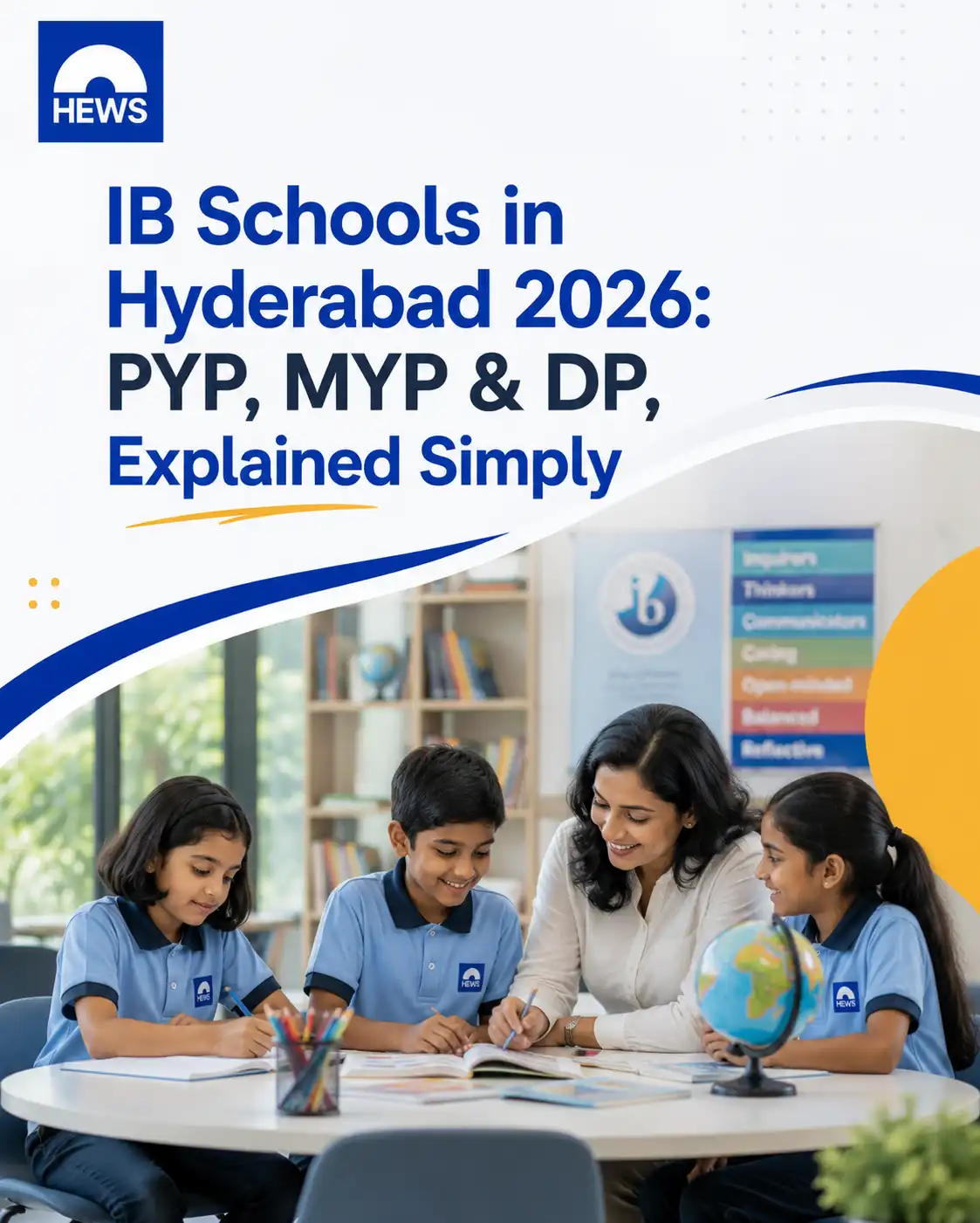
IB Schools in Hyderabad 2026: PYP, MYP & DP, Explained Simply
Not all IB schools in Hyderabad offer the same learning journey. Some provide the Primary Years Programme (PYP); others include the Middle Years Programme (MYP) or the Diploma Programme (DP); while some offer all three. This guide explains each stage in simple terms, compares IB with CBSE, and helps parents choose the right school with confidence.
Why “IB School” Doesn’t Tell You Enough
You have probably seen the phrase “IB school” on ten different websites this month. It sounds simple. It is not.
A school that says “we offer IB” could mean many different things. It could mean the full IB journey from age 3 to 18. It could mean only the senior years. It could mean the school is still building toward IB and has not started yet.
For a parent comparing International Baccalaureate schools in Hyderabad, this lack of clarity is the real challenge. You are told that a school follows the IB framework, but not which programmes it offers, the age groups they cover, or what your child’s everyday learning experience will actually look like.
The Hyderabad Parent’s Reality
Picture a typical evening on the ORR corridor, somewhere between Gachibowli and Kokapet. A parent is scrolling school websites after office hours, phone in one hand, dinner half made.
Every site says “IB curriculum.” None of them explain what that curriculum stage actually covers for a 4-year-old versus a 14-year-old. So the parent ends up comparing schools on things that are easy to compare, like fees and bus routes, instead of the one thing that matters most: what will my child actually learn, and when.
This is not a small gap. A child’s early years shape how they think, ask questions, and handle challenges later. Choosing a school without understanding the stage your child will actually join can mean years of mismatch between what you expected and what your child gets.
PYP, MYP, DP and CP: What Each Stage Really Means
The International Baccalaureate, or IB, is a globally respected framework used in many countries. It has four stages, and each one is built for a different age group.
IB Stage | Full Name | Age Range | What It Focuses On |
PYP | Primary Years Programme | 3 to 12 years | Inquiry, curiosity, and learning through questions rather than only textbooks |
MYP | Middle Years Programme | 11 to 16 years | Connecting subjects, real-world problem solving, and independent thinking |
DP | Diploma Programme | 16 to 19 years | A two-year, exam-based senior school qualification recognised by universities worldwide |
CP | Career-related Programme | 16 to 19 years | Academic study combined with career-related learning, for students who want a more applied path |
Note: IB programme age ranges can overlap. The PYP is designed for students aged 3–12, while the MYP is designed for students aged 11–16. This means students aged 11–12 may fall within the age range of either programme, depending on the school’s grade structure and implementation.
A school does not have to offer all four IB programmes. Some schools offer only one or more stages, while others provide a longer IB pathway across different age groups. A child may also move into the IB at a later stage after studying under CBSE, ICSE or another curriculum. This is why the phrase “IB school” alone tells you very little. You need to know which programme the school offers, the age or grades it covers, and when your child would enter that pathway.
How the IB Framework Compares with CBSE
Most Hyderabad parents grew up with CBSE, so it helps to see the two side by side.
Category | Typical CBSE Path | IB Framework (PYP–DP/CP) |
Focus in early years | Textbooks, tests, and marks from an early age | Questions, projects, and understanding over test scores |
Assessment style | Frequent exams and report cards | Ongoing project work, with formal exams only from the senior stage |
Subject approach | Subjects taught separately | Subjects often connected through real-world themes |
Outcome universities look for | Strong exam scores | Independent thinking, research skills, and clear communication |
Neither path is wrong. The point is to know which one matches how you want your child to spend their early years, and what the school in front of you is actually offering.
A Practical Guide: What to Ask Before Shortlisting IB Schools in Hyderabad
Before you shortlist schools offering the IB curriculum, ask these questions directly:
Which IB stage does the school currently offer: PYP, MYP, DP, or CP?
Is the stage already running, or is it planned for future years?
What does the school follow before IB begins, if IB only starts in the middle or senior years?
What is the student-teacher ratio in the early grades?
How is your child assessed day to day, not just at year-end?
What does a typical school day actually look like, in hours and activities?
A school that answers these clearly, without vague brochure language, is usually one worth visiting.
HEWS: Where Strong Foundations Meet Future IB Learning
If you have read this far, you already understand why the IB label alone was never enough to judge a school by.
At HEWS, we built our early years around the Finnish curriculum instead of starting with IB straight away. Children in Kindergarten and Grades 1 to 5 learn through play, questions, and hands-on projects, developed in collaboration with Finland International Education (FINE), Helsinki. This foundation is designed to prepare children for the IBMYP and IBDP stages planned for the higher grades, so the shift into IB later feels natural, not sudden.
Our classrooms keep a 1:20 student-teacher ratio, so teachers can actually notice how each child is doing, not just how the class average looks. The campus in Velmala includes a ship-themed playground your child will probably talk about at dinner.
If you are comparing IB schools in Hyderabad for the years ahead, come ahead and see how HEWS builds towards that pathway from the very start. Book a campus visit and walk through the classrooms yourself.
Why HEWS Gives You a Clearer Starting Point
Choosing between IB schools in Hyderabad should not mean decoding brochure language. It should mean understanding exactly what your child will learn, and when.
HEWS was built around that idea. A calm, play-based Finnish foundation in the early years, followed by a clear, planned route into IBMYP and IBDP as your child grows. No guessing which stage you are actually signing up for.
Take the Next Step with HEWS
Ready to see what a clear path to IB schools in Hyderabad actually looks like for young children? Book a campus visit at HEWS in Velmala and meet the team behind it.
FAQs
1. What is the difference between IB and CBSE in the early years?
CBSE focuses on textbooks and early testing. The IB Primary Years Programme focuses on questions, projects, and understanding, with formal exams starting much later, usually only from the senior stage onward.
2. Do I need to start IB from Kindergarten for my child to join later?
No. Many students join IB stages like MYP or DP after years on another curriculum. A strong foundation in curiosity and independent thinking, wherever it comes from, helps children adjust well.
3. Does HEWS currently offer full IB, from PYP to DP?
Not yet. HEWS currently offers the Finnish curriculum for Kindergarten to Grade 5, with IBMYP and IBDP planned as the school grows into the higher grades in future years.
4. What should I check before choosing among IB schools in Hyderabad?
Ask which IB stage is actually running, the student-teacher ratio, the daily class routine, and what curriculum is followed before IB begins, if it starts later. Visit the campus before deciding.
Published:
Why Parents Choose HEWS

